How an AI customer support agent works for a dental clinic
An AI customer support agent for dentistry answers patient messages, proposes and confirms appointments and sends recalls and reminders before the visit, directly in the clinic’s software. It takes over the repetitive, time-consuming part of the front desk’s work, so people have time for the patient in the chair, not for the phone that will not stop ringing. It connects to real tools used in Romanian practices, such as iStoma, Dentware or AtriumApp, and to the channels patients write on, from WhatsApp to Facebook. Below you can see exactly what it takes over, what it connects to and where a person stays at the controls.
One department, one industry. Below are the pages for each technical side and everything we connect to the agent.
- 1Customer Supportthis very page
fixed
- 2Dentistrythis very page
fixed
- 3tool / API / model / integration
see the pages below
What the customer support agent connects to in Dentistry
We connect them to the agent one at a time, across tools, APIs, models and integrations. The first ones are below, the rest are behind the button.
Dental practice software
SmilesManager
dROOT
DentManager
WhatsApp Business
Intercom
What a customer support agent takes over in a dental clinic
The front desk of a dental clinic loses hours on the same few tasks that repeat day after day. Patients asking the price of a filling, someone who wants to move an appointment, a Facebook message at 9:00 p.m. about a toothache. The AI agent takes exactly these tasks and sees them through to the end or to the point where a person is needed.
Answers frequent questions about services, opening hours, address, parking and the steps before a consultation, on WhatsApp, Facebook or the website form.
Proposes open times from the clinic calendar, takes into account the right dentist and the length of the procedure, then confirms the appointment in the software.
Sends reminders before the visit and asks the patient to confirm, to cut the no-shows that leave the chair empty.
Gets back in touch with patients who have not returned for a check-up or a professional cleaning, based on the recall list in the application.
Each of these things happens on the channel the patient has already chosen, in the language they wrote in, without the front desk being stuck on the phone while three people sit in the waiting room.
Tell us what slows you down. We talk, then decide together whether and how we work.
Appointments that go straight into the clinic calendar
Most practices in Romania already work with management software such as iStoma, Dentware, SmilesManager, DentManager or AtriumApp. This is where the calendar, the patient records and the appointment history live. The agent connects to this calendar and does not invent a parallel system. It writes to and reads from the one the team uses anyway.
When a patient writes that they want an appointment, the agent asks what hurts or which procedure they are looking for, checks which times are free with the right dentist and proposes two or three concrete options. After the patient chooses, the slot is blocked in the calendar with the name, phone number and reason for the visit, exactly as if someone at the front desk had entered it.
For clinics that already have online booking through the patient portal or through platforms like sTomato or dROOT, the agent covers the conversation that comes before, meaning the people who do not fill in a form by themselves but simply ask in chat. That way, patients are no longer lost just because nobody replied in the ten minutes they felt like writing.
Recall and reminders that reduce the empty chair

No-shows and patients who stop coming back for check-ups are two classic revenue leaks in a dental practice. Software such as Dentware or DentManager already sends automatic SMS messages a few hours and days ahead, and the agent takes this part further, because it can hold a conversation, not just deliver a dry message.
One day ahead, the agent sends the reminder by WhatsApp or SMS and asks for confirmation. If the patient says they can no longer make it, the agent immediately proposes another time and frees up the chair, instead of letting the clinic find out only when nobody shows up. The slot left open can be offered to a patient on the waiting list.
For recall, the agent works from the list of patients who should return for a professional cleaning or a periodic check-up, a list the management application already has. It gets back in touch at the right moment, with a personalized message, and turns a patient forgotten for six months into a new appointment, without the front desk calling hundreds of numbers one by one.
Messages on every channel, gathered in one place
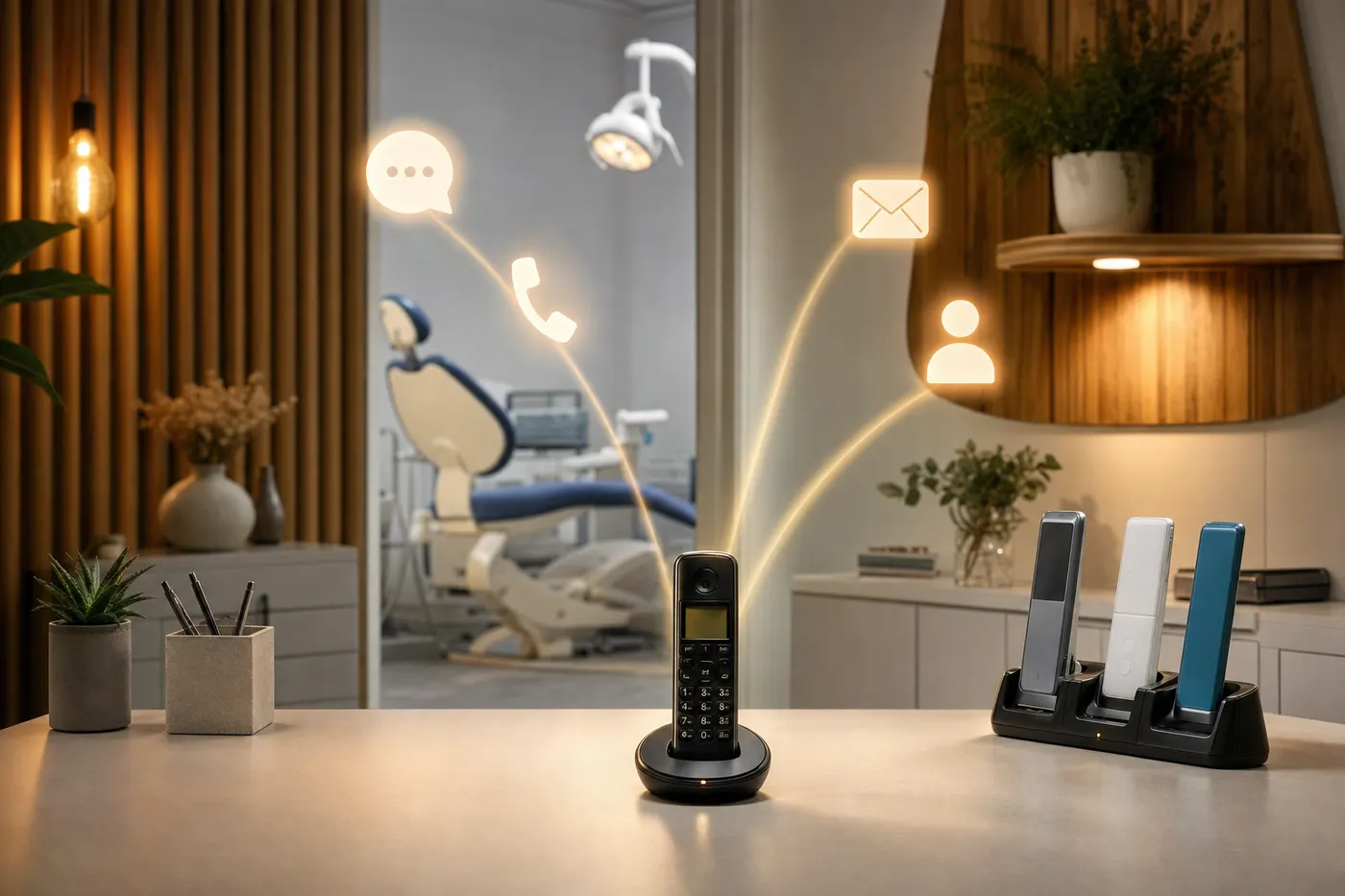
Patients write wherever it is convenient for them. Some on WhatsApp, others in Messenger on the clinic’s Facebook page, others on Instagram or through the contact form on the website. Without a system in the middle, messages scatter across three phones and two accounts, and some stay unread until the next day.
The agent sits in front of these channels and answers consistently, no matter where the message comes from. A patient who asks how much an implant costs, whether card payments are accepted or whether installment plans are available gets a clear and consistent answer, the same as the one who calls the front desk. When the question goes beyond what has been agreed, the agent takes the details and passes them to the team, with the full context, so the person does not have to ask again what has already been discussed.
For a clinic with several locations, this means every message gets the same level of response and does not depend on who is on duty at the front desk that day. And the conversations stay linked to the patient record in the software, so the history is complete.
How it connects to what you already have in the practice

A good agent does not ask you to throw away the tools you work with. It connects to the existing management software, whether iStoma, Dentware, AtriumApp, SmilesManager or DentaLog, and to the WhatsApp Business and Facebook accounts the messages already come through. In practice, it sits on top of the current workflow, not in its place.
Setup starts from the things the front desk repeats hundreds of times a month, meaning the questions about prices, opening hours, procedures and the steps before a visit. These become the agent’s answer base. As it sees real conversations, the answers get refined, and the clinic decides what the agent handles on its own and what it always escalates to a person.
The concrete result for a clinic in Romania is a front desk that is no longer glued to the phone, fewer open hours lost to no-shows and existing patients brought back for check-ups with no manual effort. The repetitive work goes to the agent, and the time gained goes to the patient in the chair.
Where a person steps in
A dental practice works with people’s health, so there are lines the agent is not allowed to cross. Anything to do with diagnosis, a treatment plan or medical advice stays with the dentist. The agent can say that severe pain calls for a prompt consultation and can propose an emergency slot in the schedule, but it does not give verdicts about what the patient has and it does not recommend treatments.
Likewise, large quotes, sensitive cases and unhappy patients are taken out of the flow and sent to a person. If someone writes in upset after a procedure or asks for clarification about a disputed invoice, the agent does not improvise. It gathers the context and hands the conversation over to the front desk or the clinic manager. Patient data is handled under GDPR rules, and local software such as QDental or Zarina CRM keeps the database right at the clinic for precisely this reason.
The idea is not to take the person out of the equation but to give them time. The agent carries the mechanical part, and the team steps in exactly where decision, empathy and medical responsibility matter.
To what we sell
The most important link on the page. From here you go up to the agent we sell.
Related links
Sideways, on the same level, so you can move easily between pages.
Questions about the customer support agent in Dentistry
Does the AI agent replace the dental clinic’s front desk?+
No. It takes over the repetitive part, meaning frequent questions, simple appointments, reminders and recall. The front desk and the dentists stay on the sensitive cases, the medical decisions and the patients who need a real person.
Which dental practice software can it connect to?+
It connects to the management applications used in Romania, such as iStoma, Dentware, AtriumApp, SmilesManager, DentManager or DentaLog, and writes appointments directly into the calendar the team already uses.
Can the agent give patients medical advice?+
It does not diagnose and it does not recommend treatments. It can say that severe pain calls for a prompt consultation and can propose an emergency slot in the schedule, but anything to do with a treatment plan stays with the dentist.
Which channels does it use to talk to patients?+
The channels patients already use: WhatsApp, Messenger on the Facebook page, Instagram and the website form. It answers consistently no matter where the message comes from and keeps the context linked to the patient record.
Tell us what slows you down. We talk, then decide together whether and how we work.