AI multichannel support agent for restaurants and cafes in Romania
An AI multichannel support agent pulls every message that reaches a venue into a single thread, from Glovo, Tazz and Bolt Food orders to reservations, menu questions and Google reviews. It confirms orders within the time the platforms require, answers the usual customer questions and drafts review replies in the venue’s voice. It connects to stock, menu and invoicing, so it can tell whether a dish has sold out or prepare an invoice for SPV. Anything involving money above a threshold, reputation or an upset customer goes through a person who reviews.

What a multichannel support agent takes over in a venue

In a restaurant or a cafe, messages do not come from one place. An order lands on Glovo, a question about a reservation arrives on Facebook, a review shows up on Google, and the kitchen asks whether there is any burger stock left. The multichannel support agent sits across all of these threads at the same time and handles each one on time, without anyone at the counter jumping from one app to another. It does not stand in for the team. It takes the repetitive part and lets people look after the dining room and the kitchen.
Delivery orders from Glovo, Tazz and Bolt Food, along with their fast confirmation to the platform and to the POS
Customer messages and questions about opening hours, the menu, allergens and table availability
Reviews on Google and TripAdvisor, with a reply drafted for each one and approved before it is published
Reservations that come in by phone, on the website or by message, with a confirmation and a reminder for the customer
In practice, the agent becomes the venue’s first layer of response. What it can solve on its own, it solves. What calls for a decision, a particular tone or an exception, it passes on to a person who reviews and decides.
Tell us what slows you down. We talk, then decide together whether and how we work.
Orders from Glovo, Tazz and Bolt Food land in a single thread

The biggest headache in a venue that delivers is that every platform has its own screen and its own pace. At peak hours, someone has to confirm the order on Glovo, repeat it on Tazz, enter it in the POS and tell the kitchen, and if a tablet goes unread for three minutes, the order cancels itself. The multichannel support agent watches all three channels at once, confirms the order to the platform within the required seconds and passes it on into the back-office flow, the way integrations such as Expressoft or BoogiT do when they connect Bolt Food, Glovo and Tazz directly to the POS and the kitchen screen.
When a customer writes that the sauce is missing from the bag or that the delivery was late, the agent gathers the order details, checks the pickup time and drafts a reply with the venue’s usual options, from resending the item to a voucher. It does not invent compensation. It proposes what the owner has already set, and any amount above a certain threshold stays with a person who reviews.
Reservations and tables that no longer go unread
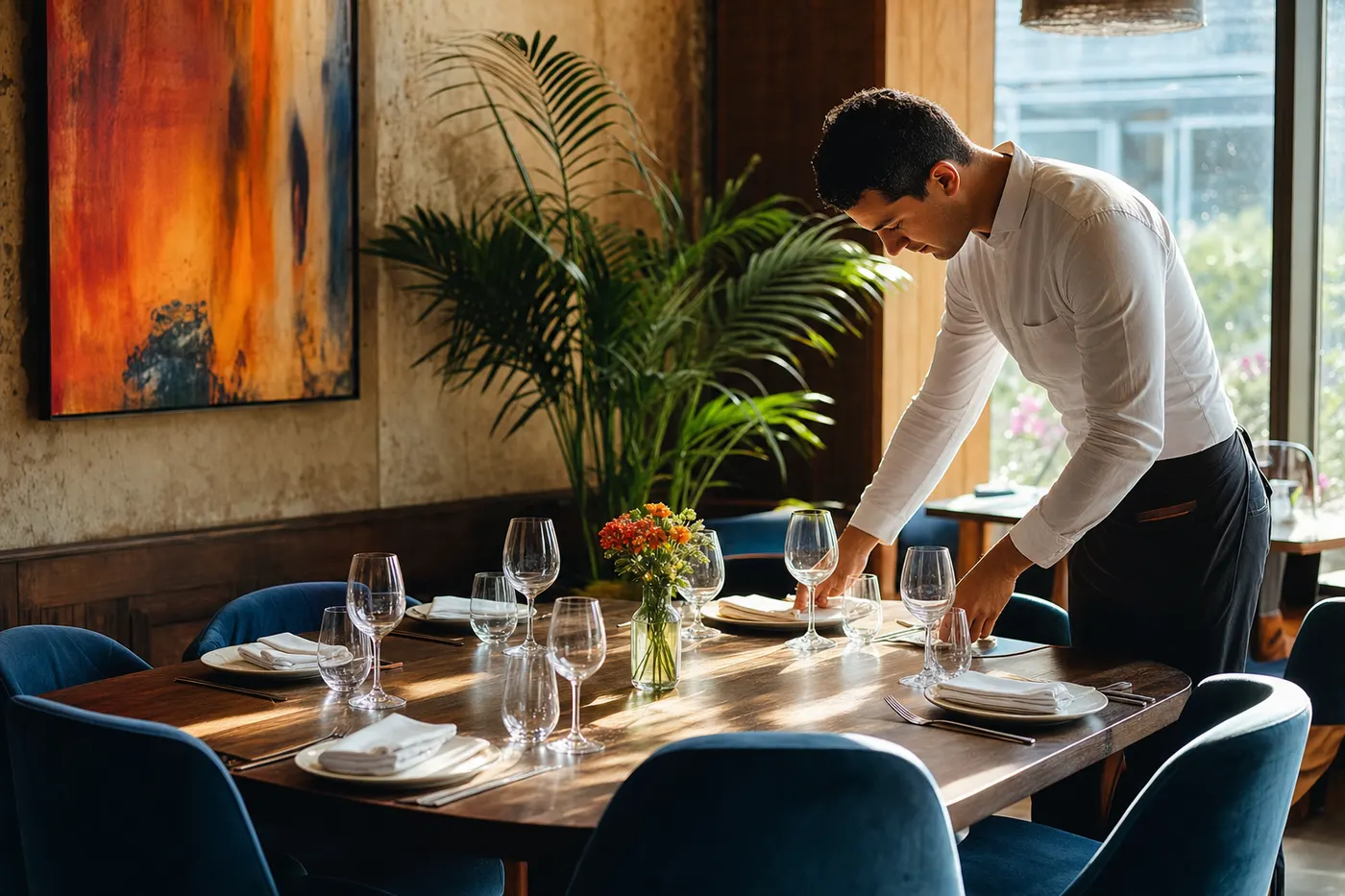
In a bistro with thirty seats, a lost reservation means an empty table on a Friday night. The agent takes reservation requests from any channel, looks at the table map and the slots already taken, and confirms or proposes another time, without anyone leafing through a notebook. The customer gets the confirmation and a reminder before the reservation, by message or email, the same way the online reservation tools used by restaurants in Romania work.
When a request comes in for a group of twenty, a private event or a special menu, the agent does not force a confirmation. It collects the details, holds the slot provisionally and passes the request to a person, because a large group affects stock, the staff on shift and the kitchen schedule. That way, small tables sort themselves out, and the ones that matter reach someone who can say yes with full knowledge of the facts.
Reviews on Google and TripAdvisor get a reply on time

A venue’s reputation rides on a few dozen reviews. A four-star review saying it was good but slow deserves a short, honest thank you, and a one-star review about a bad evening calls for care, not a copied reply. The agent tracks new reviews on Google and TripAdvisor and drafts a reply for each one in the venue’s voice, one that mentions specifically what the customer wrote, not a generic formula. The difference between a reply that comes the next day and one that comes two months later shows in how well looked after the venue appears.
For good reviews, the agent can publish the reply directly, if the owner has chosen that. For negative or delicate ones, nothing goes out without a person reading and approving it. A hasty reply to a complaint about hygiene or about an employee can do more harm than the review itself, so human oversight is not optional here.
Menu, stock and e-Factura without trips between apps

One customer asks whether you still have lasagna, another wants the allergen list, and a supplier asks for the invoice for yesterday’s order. The support agent connects to the menu and to the stock in your inventory system, so it can tell whether a dish has sold out or whether a recipe contains gluten, instead of sending someone to check in the kitchen. When a dish runs out, the agent can flag that it is worth hiding temporarily on the delivery platforms, so no orders come in for something that can no longer be made.
On the paperwork side, the agent prepares invoices from orders and sends them toward e-Factura in SPV through ANAF, using an invoicing tool such as SmartBill, and gathers the invoices received from suppliers in one place. It does not decide on its own what gets declared and what does not. It prepares everything cleanly, and the tax validation and final submission stay in the hands of the accountant or the owner, because an error on e-Factura gets paid for later.
Where the human steps in
The agent has clear limits, and that is deliberate. A few situations always reach a person who reviews before any action is taken. A serious complaint about food poisoning or hygiene never gets an automatic reply. It goes straight to the owner. Compensation above the set threshold, a special discount or the cancellation of a paid order requires human approval. A large group, an event or a request that moves stock and staff is decided by a person, not by the agent.
The rule is simple. What is repetitive and clear, the agent handles. What involves money above a threshold, reputation or an upset customer goes through a person before it goes out.
This way, a restaurant, a cafe or a bar gains time at busy hours, without losing control over the tone and the decisions that matter. The agent works in the background on the usual channels, and the team keeps the final say wherever a wrong word is costly.
To what we sell
The most important link on the page. From here you go up to the agent we sell.
Related links
Sideways, on the same level, so you can move easily between pages.
Questions about multichannel support in HoReCa
Does the agent reply to negative Google reviews on its own?+
Not without approval. For positive reviews it can publish a short thank you directly, if the owner chooses that, but for negative or delicate ones it drafts a reply in the venue’s voice and sends it to a person who reviews. For serious complaints about hygiene or safety, the message goes straight to the owner, with nothing automatic.
How does the agent connect to Glovo, Tazz and Bolt Food?+
The agent watches the three channels in the same thread and confirms orders within the time the platform requires, then passes them to the POS and the kitchen, the way Romanian integrations such as Expressoft or BoogiT do. When a dish runs out of stock, it can flag that it is worth hiding temporarily on the platforms, so no orders come in that cannot be fulfilled.
Can the agent send invoices through e-Factura to ANAF?+
It prepares invoices from orders and can send them toward SPV through an invoicing tool such as SmartBill, and it also gathers the invoices received from suppliers. It does not decide on its own what gets declared. The tax validation and final submission stay with the accountant or the owner, because an error on e-Factura gets paid for later.
Does the agent replace the staff at the counter?+
No. It takes the repetitive part, meaning messages, order confirmations, simple reservations and replies to easy reviews. The dining room, the kitchen and the decisions that involve money above a threshold, a large group or an upset customer stay with people. The agent takes the load off the team at peak hours. It does not take the team out of the game.
Tell us what slows you down. We talk, then decide together whether and how we work.